Quantum Sensing and Metrology
Understanding quantum sensing
Measurements can be made by observing individual atoms, subatomic particles and photons. Quantum sensing uses these systems to detect extremely small changes in quantities such as magnetic or electric fields with very high sensitivity. In traditional metrology, the focus is on linking measurements to standards and reducing uncertainty. In quantum metrology, the emphasis is on creating systems that behave in the same way every time, so results can be reproduced reliably.
What are quantum sensors?
Quantum sensors are measuring devices that use the quantum behaviour of atoms, electrons or light to detect very small changes in the world around us. Quantum systems are extremely sensitive so these sensors can sometimes measure things more precisely than standard instruments.
How do they work?
One important method is atom interferometry. In this technique, atoms are cooled with lasers until they move very slowly and behave like waves. Lasers then split and recombine these atomic waves. If gravity, acceleration or rotation affects the atoms on the way, the waves change slightly. Measuring the interference pattern when the waves recombine enables us to determine the size of the effect.
What can they measure?
Quantum sensors can measure a range of physical quantities, including gravity, inertial forces and magnetic fields. At NPL this includes work on gravity sensors that can help detect underground structures, inertial sensors that could support navigation when satellite signals are unavailable, and atomic magnetometers that can detect extremely weak magnetic signals.
Example: atomic magnetometer
An atomic magnetometer measures magnetic fields by observing how atoms respond to them. Atoms can be considered as small bar magnets that interact with an external magnetic field through a property called “spin”. Magnetic fields change the spin frequency which can be measured.
Lasers are used to prepare the atoms, and to detect these changes. By carefully measuring how atoms behave, scientists can determine the strength of the magnetic field with very high sensitivity. In fact, these sensors have achieved the most sensitive magnetic field measurements ever made.
Atomic magnetometers can be used in a wide range of applications, from detecting tiny magnetic signals in the human brain for medical imaging to measuring cracks in metal pipes. In 2023 some were launched into space on the JUICE mission to look for subsurface oceans on Jupiter’s moons with a view to considering whether they might support life.
Archaeology and mapping
Atomic magnetometers can detect small variations in the Earth’s magnetic field caused by buried structures such as walls, pipes or tunnels. This enables researchers to map what lies underground without digging, helping with archaeological surveys and infrastructure monitoring. For over 50 years, magnetometry have been used in mineral exploration and defence applications searching for submarines.
Example: atomic spin gyroscope
An atomic spin gyroscope (ASG) measures rotation by using the quantum property of atoms known as “spin”. Inside the sensor, atomic spins act like tiny reference points. As the device rotates, those spins shift in a predictable way, creating a measurable change in spin frequency.
By using lasers to prepare and read out the atomic spins, scientists can detect small rotations. Because atoms behave in a highly stable and repeatable way, ASGs can be extremely accurate with low drift. This makes them useful for navigation systems, especially in situations where GPS signals are not available, such as underground, underwater or in space.
How are they useful?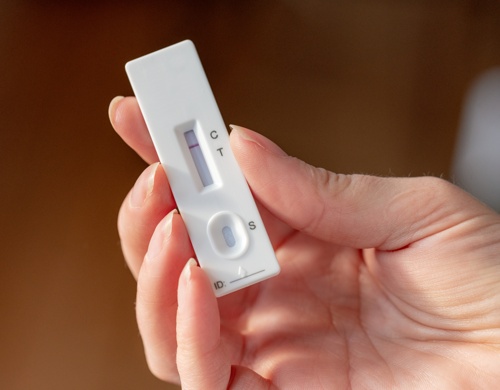
Quantum sensors can be more sensitive and stable than many conventional sensors. This means they may help scientists and engineers make measurements that are more accurate, more reliable and harder to disrupt. In the future, quantum sensors could improve navigation, support non-destructive testing, help with medical measurements and reveal features that would otherwise be difficult to detect.
How does this link to A level physics?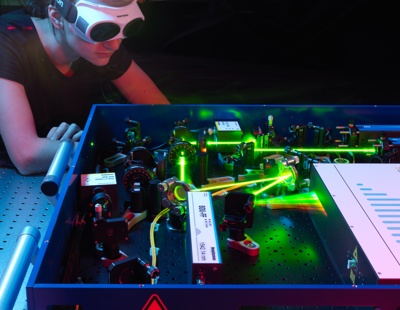
Quantum sensors connect directly to several A level Physics ideas. These include wave-particle duality, because atoms can behave like waves; interference, because the sensor compares wave paths; photon momentum, because lasers are used to control the atoms; and fields and forces, because gravity, motion and magnetism all affect the measurement. This makes quantum sensing a strong real-world example of how ideas from classroom physics feature in advanced research.
Learn more
Contact us
Our research and measurement solutions support innovation and product development. We work with companies to deliver business advantage and commercial success.
Contact our Customer Services team on +44 20 8943 7070