The Boreas Preconcentrator
Increasing the precision of methane isotope analysis
The challenge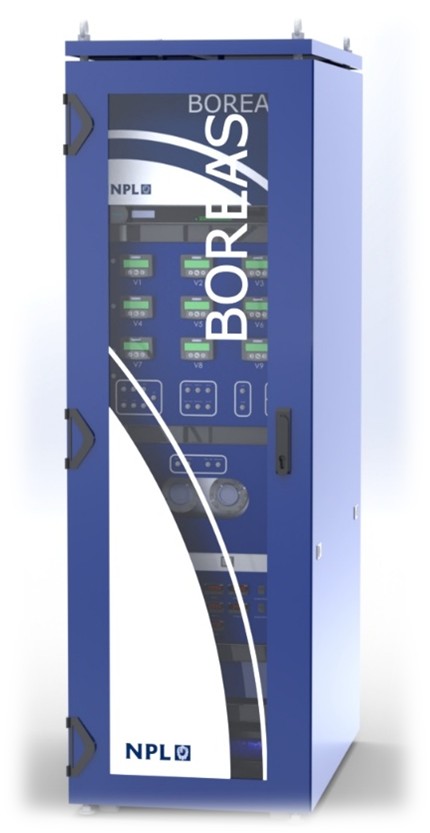
Tracking greenhouse gas concentrations in the atmosphere and identifying their source is essential for emissions quantification that support climate policy. Methane isotope ratios (δ13C and δ2H) are powerful tracers for emissions source attribution, but their low concentrations in sampled air provide a significant challenge to accurate measurement. Many current measurements therefore lack isotope ratio analysis, and techniques that can offer that — such as Isotope ratio mass spectrometry (IRMS), using flask samples — are highly labour-intensive, resulting in few samples being taken.
The solution
The Boreas Preconcentrator, developed by the National Physical Laboratory (NPL), is a high-precision instrument designed to enhance the measurement of atmospheric trace gases, particularly methane (CH₄), by improving signal-to-noise ratios and reducing matrix interference. It achieves this through cryogenic preconcentration, separating target analytes from ambient air and delivering them to analytical instruments in a purified carrier gas at elevated concentrations. When coupled with a laser spectrometer (Aerodyne TILDAS dual-laser analyser is recommended), Boreas provides automated measurement of methane isotope ratios in air samples.
Suitable for use at atmospheric monitoring stations and research laboratories, the Boreas instrument rack contains sample-handling valves, a temperature-controlled trapping system and battery-backed power distribution from a single AC inlet. The automated trapping sequence is controlled using the GCWerks software, allowing unattended operation and online data analysis.
Key features
- Self-contained preconcentration system: suitable for lab or field deployment.
- Cryogen-free cooling: Stirling cryocooler for trapping with no need for liquid nitrogen.
- Methane Enrichment: Extracts CH₄ from approximately 5 L of air (~1.9 μmol/mol) and concentrates it to ~550 μmol/mol.
- Matrix normalisation: minimises interfering gases such as oxygen, carbon dioxide and nitrous oxide. Methane delivered to spectrometer in high purity nitrogen carrier gas.
- Automated Operation: Fully computer-controlled operation of trapping cycle and carrier gas flow using GCWerks software. Suitable for deployment to atmospheric monitoring stations. 6-inlet sample selector for ambient air and standard gases.
- Continuous monitoring: typical 10-minute integrated sampling duration and 1 hour cycle time.
- Isotopic Analysis for methane: If coupled to the recommended Aerodyne TILDAS Dual Laser CH4 Isotope analyser enables precise δ¹³C(CH₄) (~0.07 ‰) and δ²H(CH₄) (~0.9 ‰) measurements from an ambient air sample. The analyser is not supplied with Boreas.
- Flexible preconcentration system: can be configured for other target species. Contact NPL to discuss custom applications, control and analysers.
Find out more
Links to technical papers:
Fractionation of Methane Isotopologues during Preparation for Analysis from Ambient Air
Contact us
Our research and measurement solutions support innovation and product development. We work with companies to deliver business advantage and commercial success.
Contact our Customer Services team on +44 20 8943 7070