Kamal Hossain international secondment scheme
4 minute read
Sam Flynn shares his experience of the Kamal Hossain International Secondment Scheme. Month six: innovation, imaging and international perspectives
Hello, I’m Sam Flynn, and I work in the Radiotherapy and Radiation Dosimetry group at NPL. I’m currently on secondment at the Metrology Research Centre within the National Research Council (NRC) in Canada. This placement is part of the Kamal Hossain International Secondment Scheme, and it’s given me the opportunity to step outside my usual environment and explore how another National Measurement Institute approaches shared challenges in medical physics. Over the past six months, I’ve been learning, collaborating and reflecting on what makes NMIs so vital to both science and clinical practice. If you missed my previous blog post, you can catch up here.
For my final month in Canada, I’ve been moving from theory to practice; running experimental proof-of-principle tests based on the simulations I’ve been developing over the past few months. It’s been an illuminating process, full of surprises. To quote my friend and collaborator: “This has no right looking as good as it does!”
One of the fascinating aspects of working within an NMI is the pace of change. Things often move slowly; and that’s by design. Rigour, traceability and consistency are paramount; rapid changes or deviations can undermine the very foundations of measurement science. But there’s a flip side: sometimes long-standing practices remain unchallenged, becoming almost dogma, rooted in experiments carried out decades ago and passed down as ‘the way it’s done.’
Seeing unexpected results doesn’t mean we’ll overturn established methods overnight, but it does open the door to new thinking. It reminds us that even in metrology, innovation often starts with asking, “Why do we do it this way?”. This is something that we’re very interested in exploring together in the future, hopefully building a strong trans-Atlantic research partnership.
On a practical note, I finally received some of my calorimetry equipment from NPL, after an extended stay in customs that lasted more than two months! The team here was eager to compare approaches and explore the possibilities, but with limited time left we couldn’t complete the planned tests. Still, the demonstration went well and my hope is that this collaboration will continue beyond my return to the UK, building on the groundwork we’ve laid here.
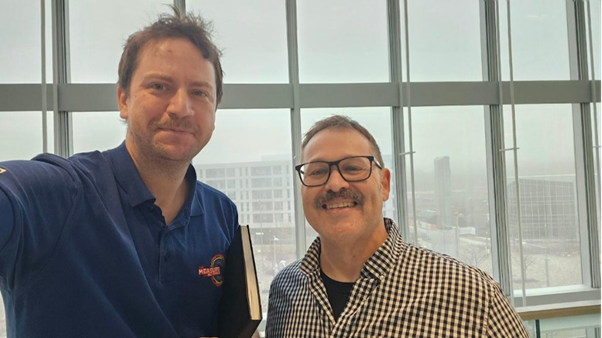 Photograph of me (left) with Professor Bouchard (right).
To conclude my interview series, I spoke with Professor Hugo Bouchard from the Université de Montréal. His career spans research roles at two National Measurement Institutes: NRC in Canada, where he completed his PhD, and NPL in the UK, where he contributed to advances in small-field dosimetry, accurate film dosimetry, and dosimetry in magnetic fields. That latter work laid the foundation for accurate measurements in MR-guided radiotherapy; a contribution he continued to develop after returning to Canada as a professor, through PhD collaborations and scientific visits to NPL. Earlier in his career, Hugo also worked as a clinical physicist, giving him valuable insight into the practical challenges faced in healthcare. This unique perspective, bridging clinical experience, academic research and metrology, made him an ideal person to discuss the evolving role of NMIs in science and healthcare.
Professor Bouchard spoke very positively about his experience working with NMIs, describing them as both essential technical authorities and collaborative research partners:
“NMIs are a very rich environment to do good science… I think NMIs can play a good role both as a service provider and as a scientific partner for research collaborations. I am the living proof of that.”
His career trajectory – spanning NRC, NPL, and clinical practice – illustrates how NMIs create opportunities for innovation while maintaining the rigour and traceability that underpin safe and effective treatments.
When asked about the greatest impact NMIs like NPL and NRC could have in the coming years, Hugo emphasised the need for stronger representation in medical imaging and diagnostics, particularly MRI and CT:
“Anything for which a quantity is crucial to clinical decisions should be traceable.”
He argued that while dosimetry has long been a cornerstone of NMI activity, imaging remains an area where metrology principles are less embedded. For example, MRI is used routinely in diagnostic radiology and informs diagnoses and clinical decisions that are often based primarily on image contrast, rather than on physical properties of human tissues reliably extracted from the images. This limits the full potential that such a modality could bring to the clinic. Hugo sees NMIs as uniquely positioned to bring rigour and consistency to these processes; ensuring that clinical decisions are grounded in traceable, physical quantities rather than unverified data interpretations:
“NMIs are still there to relate everything that we do to physical quantities and physical phenomena that are known and understood.”
Similarly, regarding the application of Artificial Intelligence and other data-driven methods into the clinic, and the role of NMIs in the future, Professor Bouchard said: “Data science has opened the way for interpreting data without the need to link it to physical processes. For that reason, associated risks should be carefully evaluated before clinical use. NMIs are still there to relate everything we do to physical quantities and phenomena that are known and understood, thereby ensuring that research applications remain grounded in physical reality.”
This reinforces the critical role NMIs play; not just in calibration and standards, but in ensuring that emerging technologies remain grounded in rigorous, traceable science. NPL is already advancing this work through its MRI metrology research and its efforts in Data Science and AI, aiming to build trust in data-driven technologies and support their safe adoption in healthcare and beyond.
Hugo’s experience across both NMIs gave him a nuanced sense of how their day-to-day work has evolved in different directions. His reflections resonated with what I’ve observed during my time here: many of the differences between NPL and NRC seem to stem more from geography and history than from any fundamental difference in outlook. In the UK, NPL can quite literally drive to every cancer centre, which has made close, practical collaboration a natural part of its role. In Canada, where clinical sites are spread over vast distances, NRC’s strengths have grown in areas that scale nationally and internationally; including major computational contributions such as EGSnrc, which underpins Monte Carlo work around the world, and remote support. My NRC host, Malcolm McEwen, has recently taken on the presidency of COMP, highlighting just how strongly NRC remains connected with, and actively engaged in, its medical physics community. Over my secondment I’ve seen how these perspectives complement each other: NPL working closely with collaborators on specific experimental challenges, and NRC advancing tools and methods that support the whole field. Neither approach is inherently more clinical or more research‑focused; they simply reflect the contexts in which each NMI operates.
Similarly, the way Codes of Practice are implemented reflects these differences. In Canada, TG-51 emphasises teaching medical physicists how to determine dosimetry from first principles, fostering flexibility and deeper understanding. In the UK, the approach is more prescriptive, specifying measurement conditions to enhance standardisation, sometimes at the cost of flexibility. From my time at NRC, I think this is why the two NMIs complement each other so well. Neither approach is fundamentally better. Seeing both perspectives has been fascinating.
As I wrap up my time in Canada, I’m struck by how much NMIs influence and are influenced by healthcare; not just through calibration and standards, but through collaboration and innovation.
11 Mar 2026