- Home
- Products and services
- Time and frequency
- NPL Network Time Protocol (NTP) service
- Network Time Protocol (NTP) user guide
Network Time Protocol (NTP) user guide
The National Physical Laboratory (NPL) operates the national time scale UTC(NPL) and maintains the UK’s primary frequency standards. These are used to contribute to global timekeeping and to distribute precise time and frequency information to users across the UK through services such as the MSF radio time signal, network time, and NPLTime®.
The National Timing Centre (NTC) is a major programme led by NPL that was initiated to develop the UK’s first nationally distributed time infrastructure. The NTC programme strengthens the resilience of the UK’s time and frequency services, enabling innovation in technologies such as 5G and 6G communications, smart cities, satellite links, and autonomous vehicles.
In 2025, NPL upgraded its Network Time Protocol (NTP) service with the addition of three diverse server locations and hardware timestamping to enhance the resilience, reliability and accuracy of network time. The project was funded by the UK Government’s Integrated Security Fund and delivered by NPL in collaboration with the National Positioning, Navigation and Timing (PNT) Office, established by the Department for Science, Innovation and Technology (DSIT).
The Network Time Protocol (NTP) enables a computer to set its internal clock accurately by connecting to a remote NTP server operated by NPL. NTP transmits precise time codes over the Internet, ensuring that the internal clock of an end user’s computer is continuously synchronised to the national time scale – UTC(NPL), a trusted source.
Every computer timestamps key events such as sending an email or saving a file using its internal clock. Most computer clocks rely on inexpensive quartz oscillators that can drift by several seconds per day and accumulate errors of many minutes over time. To maintain accuracy, the clocks must regularly synchronise with a highly accurate external reference.
NTP is mostly used to synchronise computer clocks across a data network at the application layer, which is the highest level in the conceptual OSI model. NTP was developed by Professor David L. Mills at the University of Delaware in the early 1980s. In 1985, NTP version 0 was introduced and documented in RFC958. It contained the first specification of the NTP packet header and offset/delay calculations, which are still used today.
Over time, the early version of the protocol evolved and was optimised into the current versions NTPv3 and NTPv4, with ongoing improvements to both specification and implementation. NTPv4 was designed to support newer platforms and operating systems. In 1992, a simplified version called SNTP (Simple Network Time Protocol) was first developed for circumstances where the performance of full NTP implementation was not required. It uses the same packet format as full NTP but operates in a stateless remote procedure call mode, described in document RFC2030. Additional security in NTP is available through authentication, whereby NTP client IP addresses are assigned a unique encryption key. Authenticated NTP enables users to verify that NTP messages were received from the intended server and have not been modified in transit.
NTP was first developed for use on Unix systems. However, implementations are now available for most other operating systems including Linux and Microsoft Windows. The protocol uses UTC for timestamping and packets include information about upcoming leap seconds. No information is transmitted concerning time zones or daylight-saving time, which are handled locally by each device on the network.
An NTP user should connect to multiple servers and select the best one based on a calculation of which is providing the most accurate time. Physical proximity and network stability will have a large effect on the accuracy of the time available from any given server.
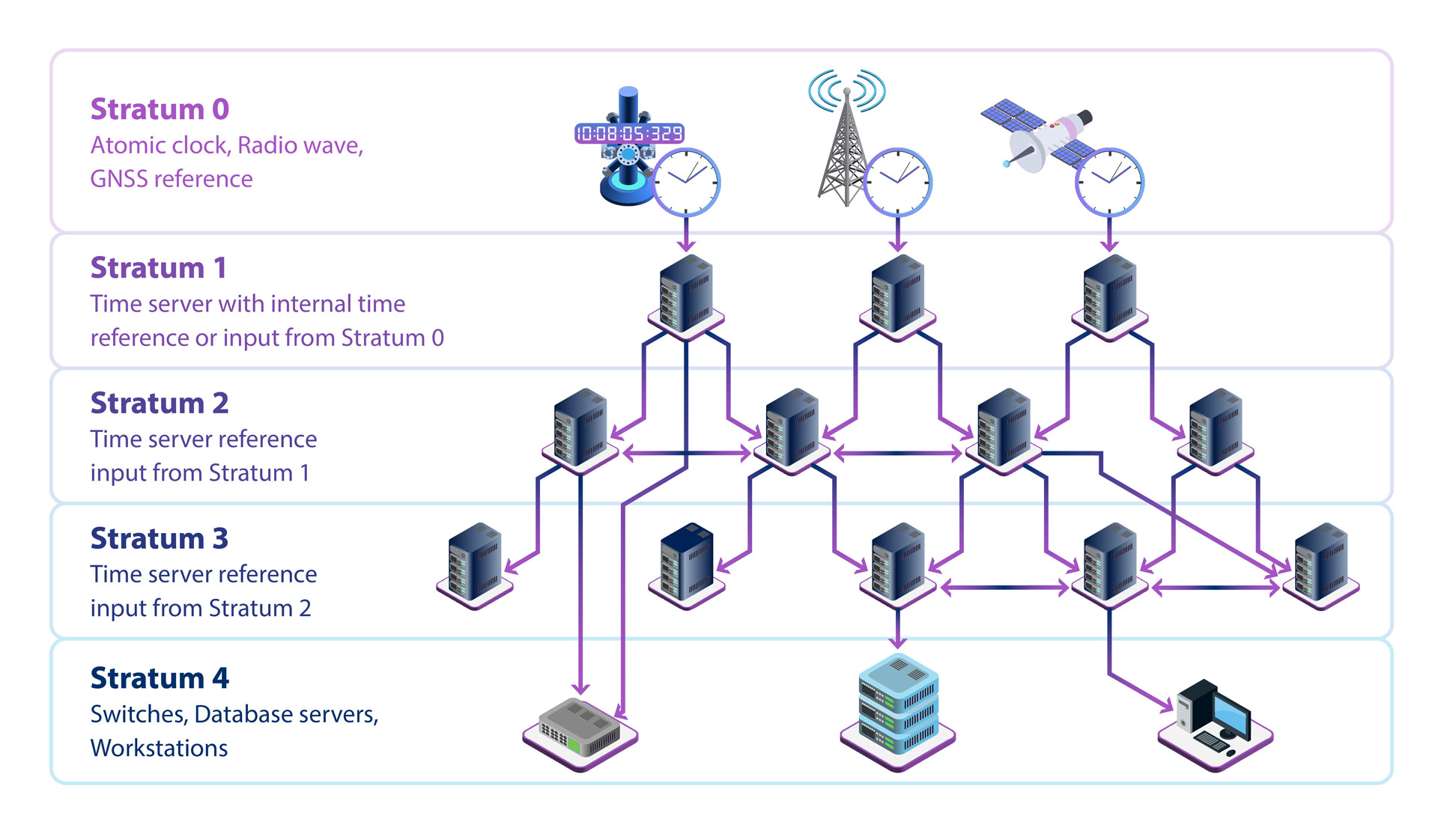
NTP is implemented using the UDP protocol on port 123. It uses a layered system of resources where each level is called a stratum, numbered from 0. Stratum 0 represents the top-level reference time source, such as from National Metrology Institutes, Global Navigation Satellite System (GNSS) receivers, radio time sources, caesium frequency standards. A stratum 1 server takes its time directly from one of these sources; a stratum 2 server takes its time from a stratum 1 server; stratum 3 from stratum 2, and so on. The highest stratum is 15, with stratum 16 representing a server that is not synchronised. The time accuracy available decreases with every increasing stratum number, due to the accumulated uncertainties of the servers at each level. Several public NTP servers are available on the internet, where the reference time may be provided via an atomic caesium clock, a GNSS receiver or radio time broadcast such as MSF or DCF77.
Many NMIs, such as NPL, provide an NTP service which is referenced to their local representation of the global primary time standard, UTC, and available worldwide via the internet. Examples include the German National Metrology Institute’s (PTB) publicly accessible NTP servers, offering NTP services which include authentication and security. The Swedish Distributed Time Service, operated by Netnod (a Nordic Internet Exchange), is continuously monitored and steered to follow UTC(SP) by the Research Institutes of Sweden (RISE) and offers NTP and Precision Time Protocol (PTP) services. The National Institute of Standards and Technology (NIST), in the US, operates several stratum 1 network time servers, which means their time is directly linked to UTC(NIST) and an authenticated NTP service is also available.
The NTP client sends the first message, which the server responds to. Each send or receive of a message is timestamped, resulting in four timestamps t1, t2, t3 and t4. The delay between the client and server could be measured simply using timestamps t2-t1 and the delay between the server and client by t4-t3, however since the two clocks may not be synchronised, a correction must be applied. Because the network may be asymmetric, this correction can only be estimated, not calculated precisely.
The average one-way delay is: ((t4 − t1) − (t3 − t2))/2
The clock offset is estimated as: ((t2 − t1) + (t3 − t4))/2
Network asymmetry therefore leads to error in the clock offset, which may be mitigated to an extent using the NTP algorithms which make multiple measurements to multiple servers in a robust architecture.
Every computer has a built-in clock to maintain system time, which can be configured to synchronise with one or more NTP servers. Most operating systems have a built-in NTP or SNTP client that is pre-configured to synchronise to the most appropriate server(s) for the environment it is running in. In addition to the NTP clients provided with different operating systems, there are also other applications available. These can offer additional customisation features, such as the display of multiple time zones and a selection of specific NTP servers to use. To summarise, NTP typically achieves an accuracy of 1 millisecond over a local area network and several tens of milliseconds over a wide area network. It works without requiring special hardware on client devices. NTP uses a client-server communication model, with many public servers available. A single server can typically support hundreds of thousands of clients.
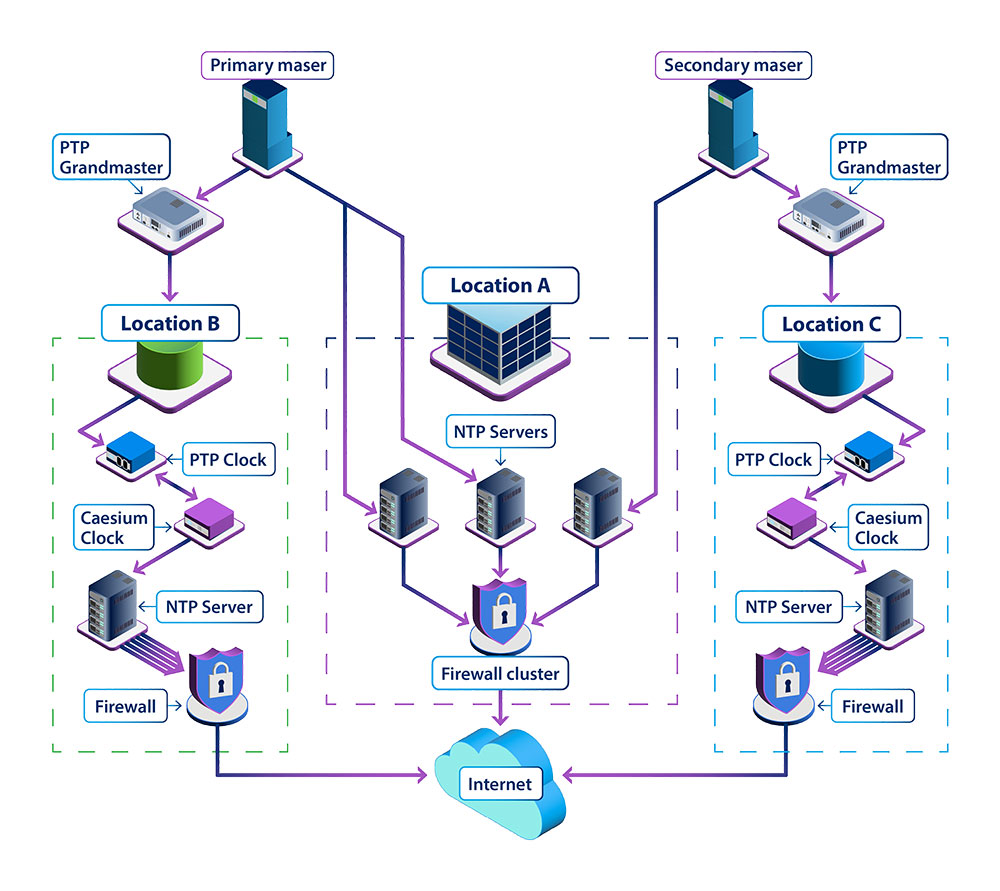
NPL offers five independent NTP servers that provide access to the UK’s national time scale, from three different locations. NPL’s NTP servers operate on NTP version 4 and employ specialised precision cards that support hardware timestamping, improving accuracy.
The current NTP servers are strategically deployed in diverse geographic locations interconnected by dedicated dark-fibre links to UTC(NPL) at Teddington for maximum resilience. The internal clocks on these servers are maintained within ±50 nanoseconds of the national time scale - UTC(NPL), however for end-user devices, accuracy to UTC(NPL) depends on the characteristics of the network path and the user’s implementation of the NTP.
Name | Host (DNS) Name | Server location |
NTP Server 1 | ntp1.npl.co.uk | Location A |
NTP Server 2 | ntp2.npl.co.uk | Location A |
NTP Server 3 | ntp3.npl.co.uk | Location A |
NTP Server 4 | ntp4.npl.co.uk | Location B |
NTP Server 5 | ntp5.npl.co.uk | Location C |
NPL’s servers are synchronised to 1 pulse-per-second signals derived from NPL’s atomic clocks. The servers are therefore classed as stratum 1 and are independent of GNSS. This approach provides a robust alternative to GNSS that maintains accurate time even when satellite signals are degraded or unavailable. Prior to launch, NPL's NTP service was independently assessed through third-party penetration testing.
NTP is one of the most widely adopted protocols for time synchronisation applications and is used extensively across many industry sectors.
NTP is a popular protocol because it is reliable and widely supported across operating systems and network devices, making it easy to implement in diverse environments. Its ability to maintain precise time synchronisation over IP networks is critical for security, logging, and compliance. NTP also supports hierarchical time distribution, allowing organisations to use multiple time sources for redundancy and accuracy. Furthermore, its long-standing presence and open standard nature have made it the de facto choice for applications where ±1ms accuracy is required.
Many organisations synchronise their systems directly to Global Navigation Satellite Systems (GNSS) such as GPS. However, GNSS can be subject to external interference, including space weather events that disrupt satellite communications.
It is therefore important to consider other sources of time, such as a ground-based system, to ensure continuous network synchronisation and accurate timekeeping.
The benefit of computers being synchronised to an accurate and reliable source of network time includes improved performance, data integrity and security, as well as operational efficiency.
Contact us
If you have any questions about NPL’s NTP service, please get in touch with the NPL NTP service team