Scanning thermal microscopy
Mapping temperature and thermal conductivity
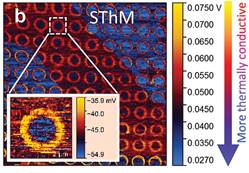
Scanning thermal microscopy (SThM) is used to map the temperature or the thermal conductivity of a sample's surface or interface. The SThM probe has a nanoscale resistor on the probe's apex and the resistance of the probe is actively monitored for an indirect measurement of thermal properties.
SThM is performed in either a passive or active mode. In the passive mode, the probe resistance is monitored as a function of the probe position across the sample plane, spatially mapping the surface temperature distribution. This mode has suitable for nanoelectronics as it can provide precise locations of excessive heat generation and temperature gradients across materials and devices. In the active mode, the power supplied to the probe is controlled through a feedback mechanism in order to sensitively map the thermal properties of a sample, such as distributions of the thermal conductivity or Seebeck coefficients.
Read more about our work
- Anomalous low thermal conductivity of atomically thin InSe probed by scanning thermal microscopy
- Local spin Seebeck imaging with scanning thermal probe
- Thermoelectric signature of individual skyrmions