Cryogenic materials testing
Materials used in cryogenic environments need to perform reliably under extreme conditions. Applications involving liquid hydrogen, liquefied natural gas (LNG), fusion and aerospace can expose components to extremely low temperatures that can affect their mechanical behaviour. Understanding how materials behave under these conditions is important for selecting suitable materials, improving designs and reducing the risk of unexpected failure.
NPL provides cryogenic materials testing for advanced alloys and polymer composite materials, with mechanical testing capabilities extending down to 4 K. Our experts can help to identify suitable test conditions and approaches for demanding low temperature applications.
Contact us for cryogenic materials testing services
NPL support research, material selection and technology development for demanding low-temperature applications.
Cryogenic mechanical testing
NPL provides a growing range of cryogenic mechanical testing capabilities, including:
- tensile testing
- flexural testing
- shear testing
- testing of metals and fibre-reinforced polymer composites
- testing at temperatures down to 4 K.
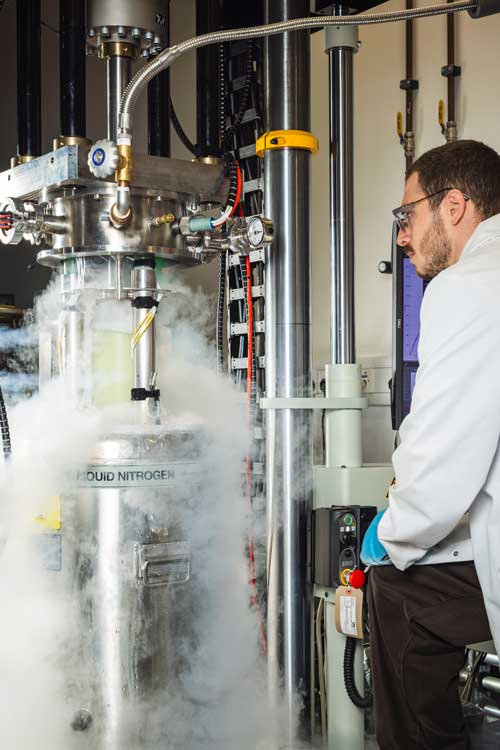
Our facilities have been developed for low temperature materials testing where factors such as specimen geometry and temperature control can influence the accuracy of the test result.
Materials we can test
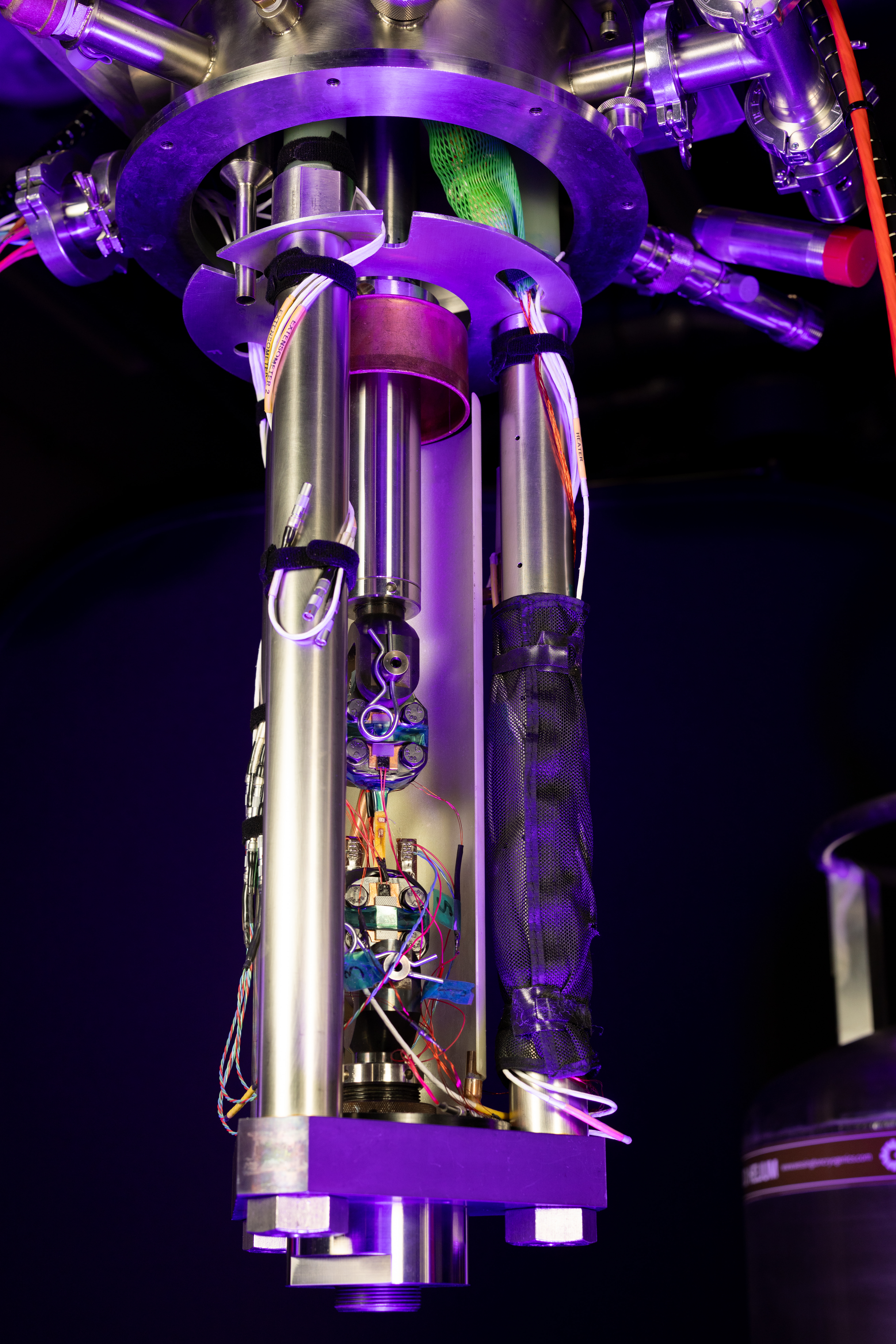
NPL provides cryogenic mechanical testing for fibre-reinforced polymer composites and metals, with test conditions tailored to the material, specimen geometry and intended application. This flexibility allows NPL to accommodate different specimen types, including flat and cylindrical metallic samples as well as larger composite specimens. The size of these composite samples can make testing particularly challenging, because maintaining consistent conditions across the test area becomes more difficult at cryogenic temperatures. To address this, NPL has developed specialist capabilities for carbon and glass fibre composites, with systems that can accommodate tensile specimens up to approximately 250 mm long under controlled cryogenic conditions.
Testing is performed in general accordance with established room-temperature standards, such as ISO 527 and ASTM D3039, and adapted as needed for cryogenic conditions.
Industries we support
Hydrogen
Materials used for liquid hydrogen applications must perform at temperatures of around 20 K.
NPL’s specialist cryogenic set-up combines helium cooling with active temperature control to achieve conditions relevant to liquid hydrogen, enabling the mechanical performance of materials to be assessed at these extremely low temperatures.
LNG
Natural gas is cooled to around -165 °C for storage and transport in a liquid form, exposing associated materials and components to extremely low temperatures. NPL uses temperature-controlled environmental chambers to create conditions relevant to LNG, allowing materials to be characterised at temperatures representative of applications such as transport, pipework and insulation. This testing can also be used to assess materials for even lower-temperature liquid hydrogen applications.
Fusion energy
NPL enables fusion-related materials testing at cryogenic temperatures, including mechanical characterisation at 77 K, 40 K, 20 K and 4 K. Our work is helping organisations to better understand material performance and improve confidence in testing at these temperatures.
Aerospace
Cryogenic materials testing can guide the development of aerospace technologies that use or interact with very low temperature fuels and environments. NPL developed its cryogenic capability partly in response to interest in liquid hydrogen as an aviation fuel, with emphasis on testing around 20 K.
Supporting reliable cryogenic testing
Cryogenic mechanical testing is an evolving field, and existing ISO and ASTM mechanical testing standards do not always address the challenges associated with testing at extremely low temperatures. As the UK's National Metrology Institute, NPL is working to improve confidence in cryogenic materials testing. Our experts are investigating measurement methods, contributing to work aimed at improving consistency between laboratories and promoting future standardisation. This expertise also means that we can help customers to determine suitable test approaches where an established method does not yet exist.
Frequently asked questions
What is cryogenic testing?
Cryogenic testing assesses how materials perform at very low temperatures. Mechanical testing can help to determine how properties, such as strength, deformation and failure, change under cryogenic conditions.
What materials can NPL test at cryogenic temperatures?
NPL can perform cryogenic materials testing on a wide range of advanced engineering materials, including speciality alloys and fibre-reinforced polymer composites such as carbon fibre-reinforced polymers (CFRP) and glass fibre-reinforced polymers (GFRP).
What temperatures can NPL test materials at?
NPL's cryogenic mechanical testing capabilities extend down to approximately 4 K. Testing can be carried out at temperatures relevant to liquid nitrogen, LNG and liquid hydrogen applications, using appropriate equipment including environmental chambers and bespoke LN2 and LHe cryostats.
What types of cryogenic mechanical testing does NPL offer?
Current capabilities include cryogenic tensile testing, flexural testing and cryogenic shear testing. NPL receives government funding under the National Measurement System (NMS) programme to develop new testing capabilities that address gaps in materials characterisation at cryogenic temperatures. Our experts can discuss your material and application to determine the most appropriate test approach.
Contact us
Our research and measurement solutions support innovation and product development. We work with companies to deliver business advantage and commercial success.
Contact our Customer Services team on +44 20 8943 7070