Can banks trust quantum computers?
Quantum computing could transform finance. But regulated industries will only adopt what they can trust – and trust needs reliable, independent measurement.
7 minute read
Every night, the world's banks run complex calculations to re-price their trading books against thousands of hypothetical futures, answering a regulatory-required question: ‘how much could we lose tomorrow?’
Modelling these real-world events in the digital realm – where everything is reduced to 0s and 1s – is mathematically complex and comes with trade-offs. That complexity, and the vast processing power required to navigate it, increases exponentially with the number of assets being modelled.
This is the sort of problem quantum computers were built for. Whereas a classical computer works through possibilities individually or in parallel, a quantum one can explore a vast, multi-parameter space – a portfolio's web of assets – in ways impossible today. A well-designed quantum algorithm harnesses quantum superposition to encode many computational possibilities simultaneously, and quantum interference to amplify the probability of measuring correct solutions while suppressing incorrect ones. Portfolio optimisation, derivative pricing and risk sensitivities – even long-term price modelling – all sit in quantum's sweet spot.
But finance does not act on numbers it cannot trust. Before quantum computers can be used for portfolio decision-making, banks must have confidence in both the process and the output: that the machine performs as intended, and the result is reliable and defensible. This is particularly hard to verify, since quantum answers are probabilistic rather than deterministic, meaning the same calculation must be run multiple times to build confidence in the answer. Additionally, on today’s hardware, verification of the results is further challenged by the effects of noise or errors.
The success of quantum in finance depends not just on the technology, but on trust. Crucial to establishing this trust is effective measurement, from assessing how well the machines perform to assuring the timing and synchronisation that allows quantum and classical computing platforms to operate reliably, while maintaining the traceability and integrity of transactions.
What we can know: from qubit to application
In problem sets such as those using optimisation, when we cannot verify a quantum answer by brute force, we can characterise the machine that produced it.
At the component level, we can measure how long a single operation takes and how its results vary when repeated. One level up, we can measure what a whole processor can reliably do. Higher still, which real-world applications it can process.
Those measurements become useful to industry when turned into benchmarks – defined, repeatable tests that help compare one machine to another. That is what NPL's QCMet suite does: packages metrics being used across the field into a common yardstick, allowing NPL, hardware vendors or end users to perform transparent assessments against that yardstick.
At the application level, measurement must meet the finance industry's needs. Classical benchmarks are being developed by STAC – an independent finance-benchmarking body – such as how quickly and reliably a system computes a set of risk factors.
Most firms that will use quantum computers do not understand their inner workings, and do not need to. A measurement-backed benchmark sets out a machine's key characteristics in plain, comparable terms, so a buyer can weigh one vendor against another, choose the right system, and keep checking that it still performs as promised. The rigour behind them – transparency, reproducibility, comparability, objectivity – is what turns a vendor's claim into something a customer can rely on.
Benchmarks are still evolving in quantum computing, and it is critical that both quantum companies and prospective users engage with the development process. By feeding back real needs and helping sift meaningful metrics from self-serving ones, they will ensure that the yardstick is fit for purpose once the hardware matures. If only a few engage, benchmarks risk becoming tests that flatter one vendor and mean little to anyone else.
Everything in the right order
Benchmarks tell us whether the sums are right. Atomic timing – itself a quantum technology – tells us whether they happen in the right order.
Finance already runs on traceable time. Rules such as MiFID II require trades to be timestamped so regulators can reconstruct who did what and when, to within a hundred microseconds for high-frequency trading. NPL supplies the industry with traceable time signals over dedicated fibre through its NPLTime® service. This ensures all institutions use time signals traceable to UTC, whilst the secure distribution mechanism ensures continuous uptime and resilience.
Quantum computing needs the same discipline. A quantum operation is a choreographed sequence of pulses at the nanosecond scale, executed against a stable frequency reference that keeps them correctly ordered and spaced. If that reference wavers, small timing errors introduce noise that can corrupt the result, the sequence degrades and increases the risk that the computation becomes meaningless.
For the foreseeable future, quantum will not replace classical computing but work alongside it in a hybrid approach, constantly passing data between two very different environments. The quantum and classical components must stay synchronised to a common reference, enabling exchanges and events to be traceable and recorded, so the flow of data remains auditable. This allows both to behave as one trusted platform running to a single shared clock.
 Traceable timestamping already happens in classical financial IT systems, data centres and telecoms networks, where internal clocks are synchronised to a common time scale – such as UTC – to ensure senders and receivers agree when things happened. Quantum adds another high-precision timing requirement. Such clocks are traditionally synchronised via GNSS satellites, but as risks of lost timing signals rise up the agenda, terrestrial backups are increasingly being sought. These include services delivered through NPL’s National Timing Centre programme, using fibre, radio waves or the internet.
Resilient, traceable timing therefore underpins not just performance, but governance, auditability and regulatory confidence. In a regulated industry, that makes it a critical factor in whether quantum computing can be adopted at scale.
Timing and benchmarks underpin trust, and ultimately adoption
Markets adopt what they can measure. Quantum's promise for finance is real, but it will only deliver when a bank can procure, install and use a quantum capability with the same confidence it places in, say, a classical tech stack running Monte Carlo models.
Credible, industry-backed benchmarks and resilient, traceable timing – both underpinned by rigorous measurement – are what turn mind-boggling physics into practical tools that finance can trust.
Collaboration will be essential to develop trusted approaches across quantum timing and benchmark development. If you are interested in engaging with NPL, please contact the team at ntc@npl.co.uk
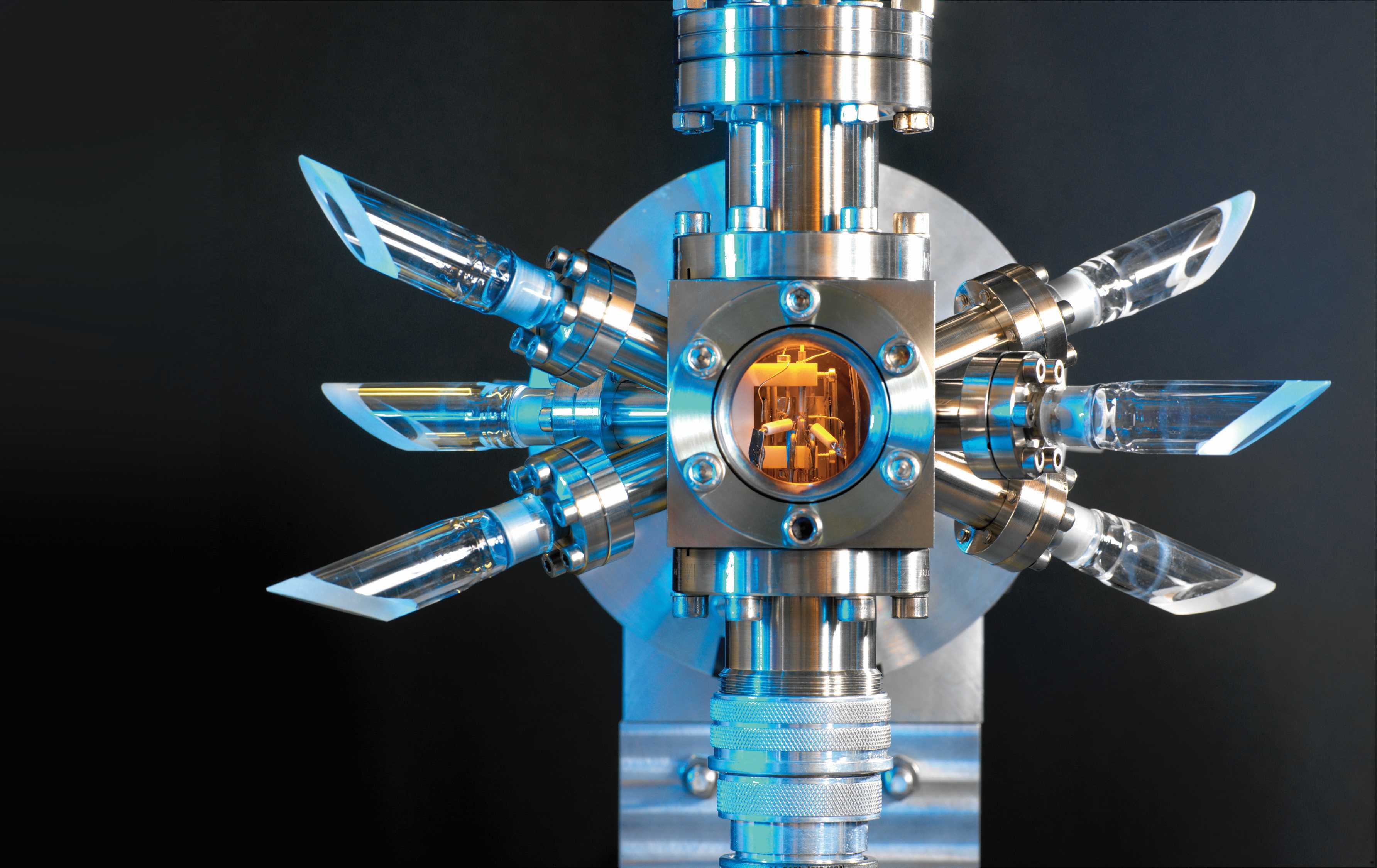
Image one: The next generation of atomic clocks at NPL using laser‑cooled trapped ions or atoms.
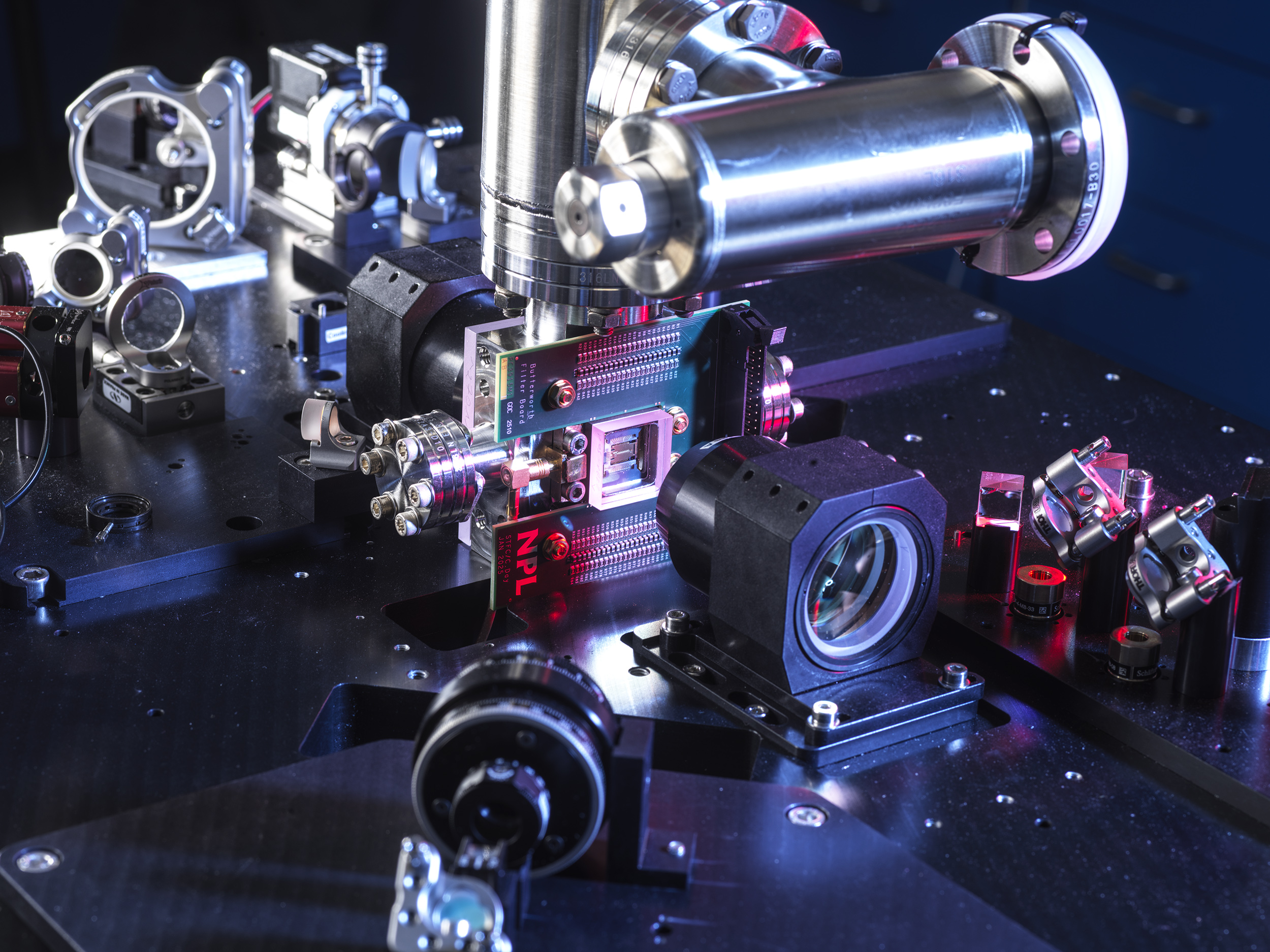
Image two: Ion trap
08 Oct 2026National Timing Centre (NTC) programme
As the home of time in the UK, we are developing the first nationally distributed timing infrastructure. NPL is enabling the UK to deliver a more resilient time and frequency service to support industry and accelerate innovation in new technologies.
The NPL Quantum Programme
NPL is helping to turn advanced quantum research into real‑world technologies by providing trusted measurement science, expert guidance and world‑class facilities. Through the NPL Quantum Programme, industry and researchers can develop quantum products with confidence and accelerate innovation across computing, sensing and communications.