Supporting early tsunami detection
New seafloor cable technology provides information to help meet crucial United Nations’ tsunami goal in the South West Pacific.
5 minute read
A team of UK and New Zealand scientists have demonstrated that a novel optical technology, when applied to existing telecommunication seafloor cables, can provide essential information to increase life safety when tsunamis strike the South West Pacific. By partnering with cable operator Southern Cross Cables Limited (“Southern Cross”), the innovative solution is being trialled to detect natural hazards in the region using a state-of-the-art optical technique called ultra-stable optical-interferometry. Using this technique, the optical fibre in seafloor telecommunication cables acts as an array of environmental sensors for the detection of earthquakes and ocean waves.
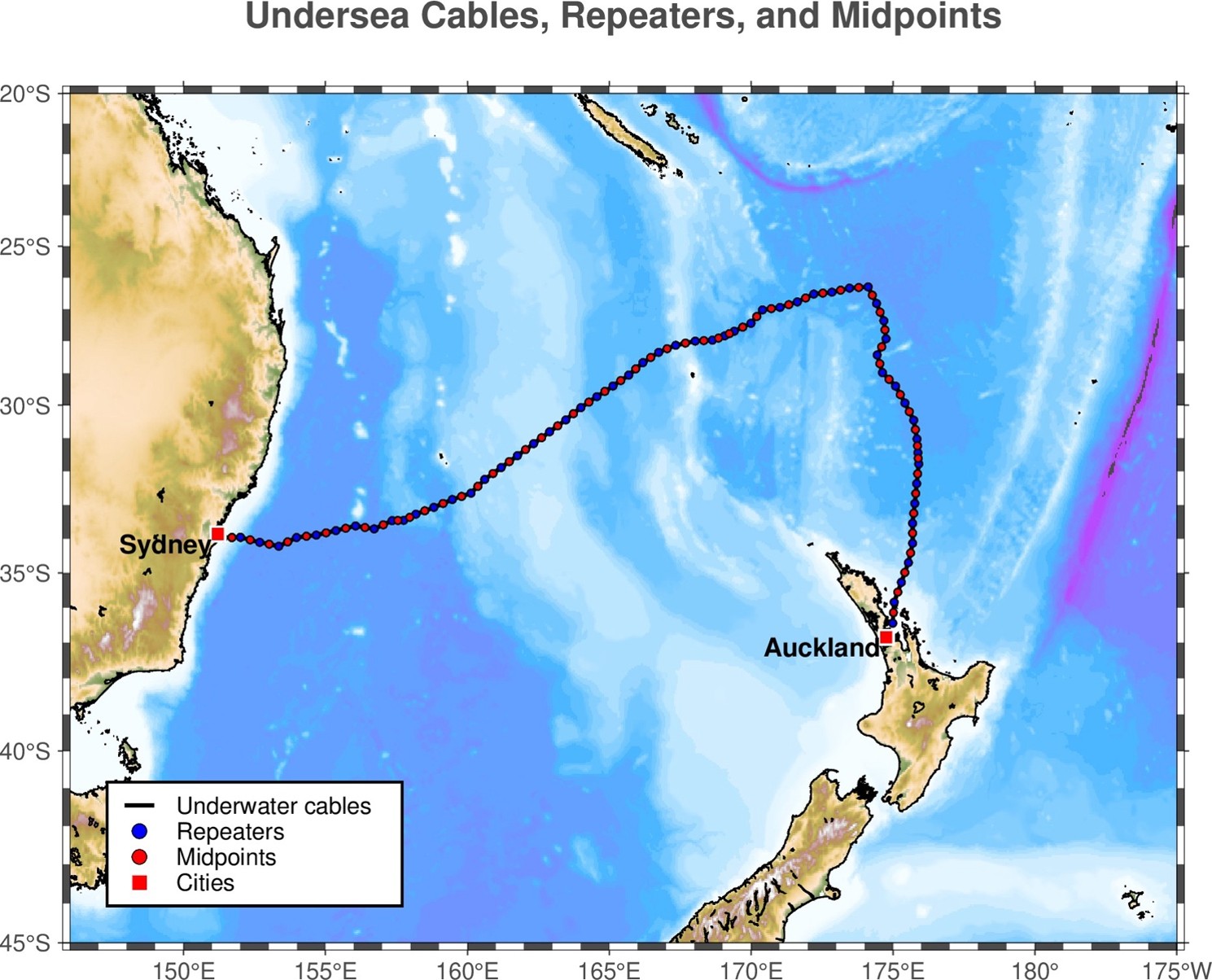
The UK’s National Physical Laboratory (NPL) is collaborating with Earth Sciences New Zealand (ESNZ), the Measurement Standards Laboratory of New Zealand (MSL) and Southern Cross to trial the pioneering detection technique on a fibre of the approximately 3,800 km-long Southern Cross NEXT telecommunications cable that connects New Zealand to Australia.
“The information provided by this technology is capable of augmenting our international monitoring network and enabling us to achieve the United Nations Ocean Decade Tsunami Programme's goal of providing actionable tsunami forecasts within 10 minutes for a lot of the region’s tsunamis,” says Dr Bill Fry, geophysicist at ESNZ.
“Our early findings suggest this cable and the methods that we are developing to harness its power may allow us to forecast tsunamis and other ocean hazards directly from ocean observations, rather than from indirect measurements. Previously, we had to look at earthquake information to forecast tsunamis, which is not good enough.”
In the observational technique developed by NPL, a laser sends ultra-stable light along the seafloor cable, which is then returned by each of the telecommunication amplifiers spaced roughly 50 to 70 kilometres apart along the cable. These returned signals enable the detection of changes across a range of environmental parameters, which are analysed to identify potential natural hazards. This then feeds into early warning strategies being pioneered by the NZ scientists and considered in the UN-IOC Tsunami Programme.
Dr Giuseppe Marra, who leads the UK side of the project, says: “It’s fantastic to see early evidence of the contribution our technology can give towards saving lives in case of natural disasters, alongside a better understanding of the ocean, which is still largely unmonitored. This is a technology that does not require new seafloor installations but uses existing subsea infrastructure. The impact on science and coastal population protection is very significant.”
The joint UK-NZ effort was funded from the UK side by the International Science Partnership Fund of the of Department for Science, Innovation and Technology (DSIT), and from the NZ-side by New Zealand’s Quantum Technologies Aotearoa programme. MSL is now working with NPL to push the technology further and enable improved sensitivity. Dr Fry continues: “We hope this leads to a revolution in our ability to map dynamic changes in the ocean even beyond tsunamis. For example, while more research is required in this area, early analysis of the data suggests detection of undersea volcano activity may be possible. The cable also presents opportunity to monitor other ocean dynamics like currents and the effects of climate change on our oceans."
Recognising the significant boost to tsunami research and public safety possible with this and adjacent technologies, the Pacific Tsunami Warning and Mitigation System has established a task team on Forecasting from Ocean Observations. This task team was created to understand how we can apply these science advances and partnerships with commercial telecommunications operators into tsunami watch operations, one of the main ways we keep our communities safe from tsunamis.
Dr Fry and Dr Marra say the partnership with Southern Cross has been key to achieve these results. The Southern Cross NEXT seafloor cable is ideally located for this type of research and the company’s enthusiasm for these innovative technologies and their potential positive impact in the region has allowed this significant milestone to be achieved.
“Southern Cross is pleased to support this important collaboration between industry and the scientific community. By working alongside NPL, ESNZ and MSL, we are helping explore how the Southern Cross NEXT cable can be used not only as critical communications infrastructure, but also as a platform for innovative ocean observation. We are encouraged by the potential for this work to strengthen tsunami detection and early warning capabilities, and to improve resilience for communities across the South Pacific.”— Mr Laurie Miller, President & CEO, Southern Cross Cables Limited
"The pioneering technology provided through this industry-science partnership is one of our most promising paths to achieve the ‘early warning for all’ goal” – Dr Fry continues. “The goal, set by the United Nations, is to provide actionable early warning to 100 percent of people at risk to natural hazards.”
Dr Johan Grand, Project Leader at MSL, says: "Working with ESNZ and our fellow metrology institute, NPL, shows how advanced measurement science can be applied to create genuine benefits for communities. Our next focus is on improving sensitivity and automating analysis to deliver a near real time capability for hazard response networks."
Additional data provided by the cable would also open up new possibilities for further research to make people safer in case of natural disasters. “We see this technology as a promising candidate for inclusion into digital twins, which harness the power of artificial intelligence to create simulations of real systems, including hazard impacts and the effects of mitigations”, says Dr Fry.
“Digital twins would allow us to issue timely ‘impact-based’ forecasts, potentially allowing us for the first time to give emergency responders information not only about the tsunami hazard headed to their shores, but also about the expected impacts on communities.”
22 Sep 2026