Metrology at sea: My first months with the MarONet team
Josh Schofield shares his experiences of the Kamal Hossain Secondment Award: Blog 2.
4 minute read
I’m Josh Schofield, a Higher Engineer in the Optical Radiometric Metrology at NPL. It's not every day you get the opportunity to swap your southwest London commute for the sunshine of Perth, Western Australia. But that's what happened to me in September 2025 when I arrived at Curtin University to begin a secondment as the 2025 recipient of the Kamal Hossain Secondment Award. If you missed my first blog, you can catch up here.
What have I been up to?
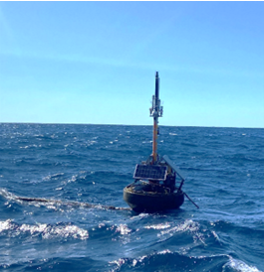
It's been hard to find a dull moment in the first few months! After arriving in Perth, I spent my time settling in and familiarising myself with Curtin University, the MarONet buoy facilities and the underpinning ocean science. In October, there were field visits to the MarONet deployment site, which is located 25 km west of Rottnest Island in the Eastern Indian Ocean. Taking around two and a half hours to reach by research vessel, this was a chance to see the buoy at sea and participate in an in-water validation cast, where radiometers are deployed from a vessel to routinely check performance of the buoy. Seeing the MarONet buoy for the first time, appearing out of the open ocean was quite the sight.
 MarONet — what is it?
MarONet is a marine optics buoy, 15 metres in height, tethered to a fixed mooring in approximately 300 metres of water, deployed ~50 km off the coast of Western Australia. MarONet is an in-situ reference for the vicarious calibration of NASA’s Plankton, Aerosol, Cloud, ocean Ecosystem (PACE) mission as well as other space-borne ocean colour sensors. It operates autonomously, scheduling measurements of the above water and underwater light field to coincide with satellite overpasses, which are then transmitted, along with environmental information back to a central server to subsequent comparisons against satellite observations. Keeping a system such as this producing high quality traceable data continuously through storms and everything else the Indian Ocean can throw at it, is a substantial undertaking and requires a highly skilled and adaptable team.
From late October through to mid-December, activities shifted to a sustained and busy period of buoy lab operations, as the team worked towards building and preparing a new MarONet instrument for deployment. This involved assembling and testing the optical instrument, integrating it with the buoy structure, running optical fibres across the buoy frame and conducting extensive pre-deployment radiometric calibrations.
 The calibration work involves performing radiance, irradiance, and wavelength calibrations at the optics collectors using NMI-traceable integrating sphere sources and lamp standards, establishing an SI-traceable and metrologically robust instrument performance baseline ahead of deployment. This kind of calibration work and equipment is very familiar territory from my role at NPL and it was a hugely informative experience applying those skills to a new application, within a new environment and set of requirements.
Stay tuned for the next blog on the recovery of the previously deployed MarONet buoy and my life in Perth.
In the meantime, a huge thank you to Curtin University, Professor Antoine and the MarONet team and to NPL for making this fantastic experience possible.
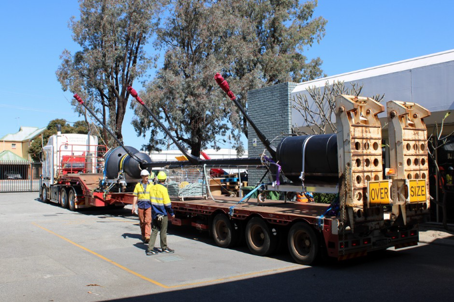
The MarONet buoy loaded on a truck ready for transport. Photo: Mike Feinholz
20 Jul 2026